
INDIA · ROAD CONSTRUCTION
Engine Warnings and Fuel Use During Paving Delays
Connect engine warnings to maintenance action and identify the diesel used during confirmed paving delays — with SMART S-4535 and a configured monitoring platform.
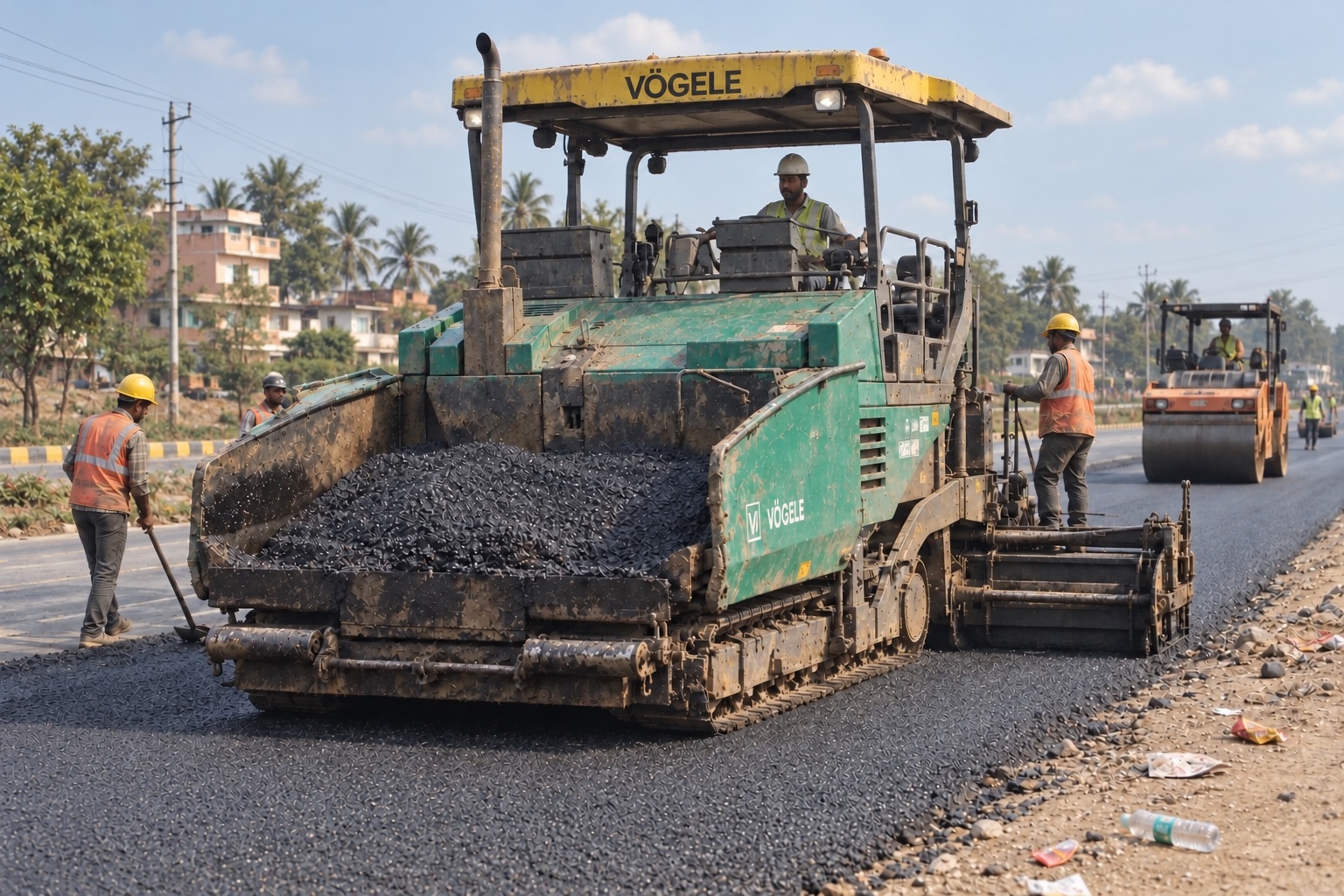

Solution device
SMART S-4535- Market
- India
- Equipment
- 4 VÖGELE asphalt paversWith ErgoPlus
- Application
- Road construction
THE CHALLENGE
Keep the paving operation moving
Engine problems interrupt a coordinated work sequence. Delivery gaps can consume diesel even when no asphalt is being laid.
An asphalt paver works as part of a coordinated operation involving the mixing plant, delivery trucks, paving crew and rollers. An engine problem can interrupt that sequence, leaving the crew and arriving material waiting while the maintenance team determines what happened.
The contractor needed engine warnings to reach the responsible supervisor with enough context to organise a response. A telephone report that the machine had stopped did not necessarily explain whether coolant temperature had risen, a warning had escalated or a fault had appeared under load.
Fuel was another concern. The engine could remain running while the paver waited for asphalt deliveries or site preparation. A daily fuel total could not show how much was used during these delays. At the same time, slow movement or low engine load did not automatically mean wasted time: paving, preparation and necessary equipment operation had to be distinguished from avoidable waiting.
HOW THE SOLUTION WORKS
From a machine event to a site decision
Respond to an engine warning
Review supported temperature, speed, load and warning records with time and location. Notify the supervisor and maintenance team with useful context. The operator must follow the manufacturer’s warning and stop procedures. Remote monitoring does not replace the dashboard or delay the required response. SMART S-4535 collects the supported engine coolant temperature, engine speed, load, warning states and diagnostic information from the paver. The configured platform places these readings alongside the time and machine location, and routes relevant notifications to the site supervisor and maintenance team. A sustained temperature excursion or warning prompts the operator to check the machine and follow the manufacturer's operating instructions. The technician can review the conditions leading up to the event and prepare the appropriate inspection. A red stop warning requires the manufacturer's prescribed response; remote monitoring does not replace the operator's dashboard or delay that response. The integrator verifies the available readings on the actual paver before enabling alerts. Warning states guide inspection; identifying the failed component still requires the correct service information.
Find fuel-consuming delays
Estimate fuel use from valid fuel-rate readings during confirmed waiting periods, then connect each delay to its recorded cause. Stationary time is not automatically waste. The supervisor confirms the work status; missing readings are not treated as zero consumption. The device also supplies engine-running status and instantaneous fuel rate. The platform can estimate fuel used over a recorded period by integrating valid fuel-rate readings over time. Missing data is flagged rather than silently treated as zero consumption. The supervisor marks the reason for a delay, such as waiting for mix, preparing the work area or an equipment check. Engine speed and load help review the operating conditions, but they do not prove whether asphalt was being laid. Confirmed waiting periods can then be compared with the fuel used during them. If waiting repeatedly coincides with gaps between asphalt deliveries, the supervisor coordinates truck arrivals with the mixing plant and paving crew. If the delay is prolonged, the operator uses the manufacturer's approved waiting or shutdown procedure when appropriate, taking account of screed heating and other operating requirements.
Compare like-for-like shifts
After a delivery-scheduling or waiting-procedure change, the team compares confirmed waiting minutes and the estimated litres used in those periods across similar shifts. A reduction matters only if it does not create extra interruptions, affect the paving process or shift the delay to another part of the operation. Maintenance reviews focus on the time between a warning and an acknowledged action, the cause found and the duration of any resulting interruption. Engine-running time can support a usage record where data coverage is complete; it is not presented as a directly decoded lifetime hour meter.
RESULTS ACHIEVED DURING THE PILOT
The same completed work. Less diesel.
According to the project results supplied by Navtelecom, fuel use decreased across comparable periods of 22 shifts.
160 litres per shift
154 litres per shift
The comparison does not establish a separate saving for each intervention or a measured reduction in breakdowns.
According to the project results provided by Navtelecom, fuel use fell from 3,520 to 3,388 litres across comparable periods of 22 shifts, with the same volume of completed work. The pilot therefore achieved a saving of 132 litres, or 3.75%.
The contractor completed comparable work with less diesel. The saving reflects the combined operating changes, rather than a separate saving attributed to each intervention.
EXPECTED ANNUAL RESULT
Maintain the shift saving over 12 months
At 264 comparable shifts per year, maintaining the pilot’s average saving of 6 litres per shift would save:
1,584 litres / year
6 L per shift × 264 shifts = 1,584 L
Expected result, not a measured annual saving. It assumes comparable work over 22 shifts per month for 12 months; seasonal operation needs a forecast based on the actual planned shift count.
At 264 comparable shifts per year, maintaining the pilot's average saving of 6 litres per shift would deliver an expected annual saving of 1,584 litres, equivalent to 3.75% of the baseline fuel use.
This projection assumes comparable work and the same average saving over 264 shifts; it is not a measured annual result.
The supervisor receives engine-warning context alongside location and time, allowing the team to coordinate incoming material while a technician prepares an inspection. Warning acknowledgement and interruption duration can be reviewed separately from fuel use.
WHY SMART S-4535
Explain machine delays with operating records
S-4535 helped the contractor decide whether a recorded interruption called for maintenance attention or a change in the delivery schedule. An engine warning could be reviewed with the conditions leading up to it; a confirmed wait could be examined for the diesel it consumed.
The site team could therefore prepare an inspection or coordinate asphalt arrivals using evidence from the paver. Telematics connected the machine’s operation to decisions affecting the whole paving crew, rather than supplying another daily engine report.
YOUR PROJECT
Tell us about the work you need to measure
Share the vehicles, routes, sensors and decisions you want this data to support.
More in this application
India · SMART S-2433
Tool-Check Warnings in Hyderabad
Six service vans. BLE equipment tags and adapted Complex Events logic prompt in-cab checks, while technician and service-visit records provide a starting point for recovery.
Explore use case
India · START S-2011
Paid Generator Rental Periods in Gurugram
Online rental extensions trigger remote restriction or release, while voltage-based operating-hour records support usage reviews across 28 generators.
Explore use case
Belarus · SMART S-4511
Timber-Truck Access and Operations in Minsk
Pilot on 10 timber trucks in Minsk, Belarus. Driver authorisation controls starting, equipment-position signals trigger a separate warning, and fuel records support investigation of specific parked events.
Explore use case